
Why Modern Ransomware Recovery Demands True Immutable Storage in the Enterprise

The High Stakes of Modern Enterprise Resilience
In the trenches of modern IT operations, the playbook for cyberattacks has fundamentally shifted. For years, the conventional guidance across security teams was straightforward: keep daily copies, isolate cold tapes offsite, and maintain an updated runbook. Yet recent cyber resilience benchmarks tell a starkly different story. According to recent cross-industry studies, including research published by Cohesity, over 50 percent of global enterprises fell victim to successful ransomware intrusions over the past year. Even more alarming, an overwhelming proportion of these victims felt compelled to pay ransoms simply because their recovery pipelines were compromised alongside primary production.
Today’s sophisticated threat actors no longer stop at encrypting active workloads. Instead, they dwell undetected within environments for weeks, mapping directory structures, hunting down administrative credentials, and silently poisoning snapshots or purging volume shadow copies. When recovery systems share management control planes or read-write access mechanisms with primary infrastructure, traditional failover breaks down entirely. Achieving true operational survival requires moving beyond baseline retention to implement non-negotiable ransomware recovery mechanisms built directly into the storage layer.
The Critical Flaw in Legacy Backup Workflows
Why do conventional secondary stores fold under targeted attacks? The root vulnerability usually comes down to privileged escalation and exposed access boundaries. In legacy architectures, backups are stored on standard network-attached storage or storage area networks that honor common API commands like deletion, format, and volume pruning. If an attacker acquires administrative tokens—whether through sophisticated phishing, lateral movement, or stolen credential dumps—they possess the identical authority required to erase the very backups designed to rescue the enterprise.
Moreover, modern threat groups deliberately target complex transactional clusters. Relational engines hosting transactional ledgers, customer records, and operational state require specialized protection policies. When databases are locked, business stops immediately. Without specialized snapshots and isolation, standard volume dumps often yield corrupted, unbootable instances that force teams into panic mode.
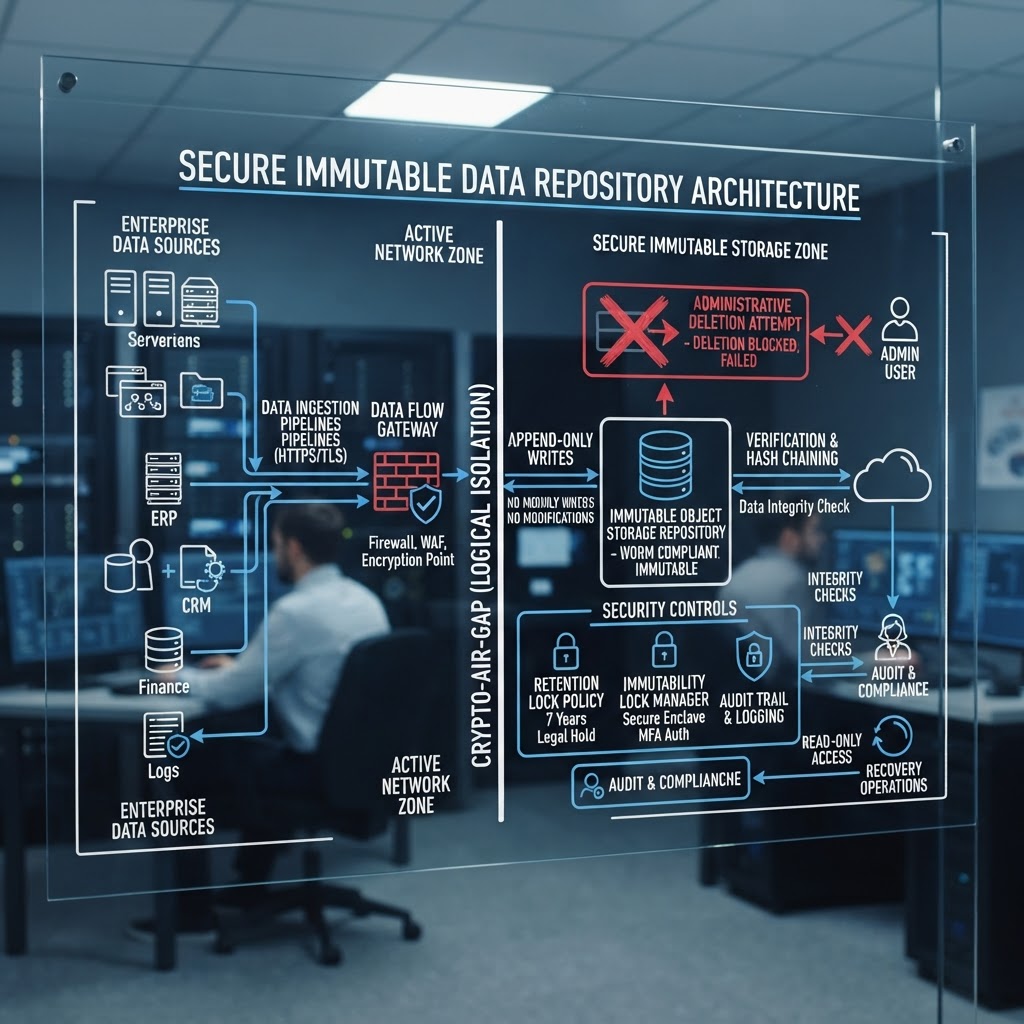
Guaranteed Resilience Through Immutable Storage
The only architectural answer to this threat model is mathematically and cryptographically enforcing an append-only state. By deploying true immutable storage, engineering teams eliminate the possibility of any actor—internal or external, rogue admin or sophisticated ransomware binary—altering, overwriting, or deleting stored objects before a predetermined, regulatory-grade retention timer expires.
WORM (Write Once, Read Many) technology has migrated from rigid hardware tape silos to dynamic, software-defined platforms. Modern immutable architectures ensure:
- Object-Level Lock Enforcement: Data blocks cannot be truncated or dropped even if root credentials are hijacked on the backup controller.
- Air-Gapped Control Planes: Separation between data ingestion workflows and governance oversight prevents administrative override attacks.
- Integrity Verification: Continuous, automated background hashing detects silent bit rot or tampering attempts before a full restore is initiated.
Securing the Modern Enterprise Data Fabric
Storage immutability cannot live in a vacuum; it must seamlessly integrate with mission-critical applications across the distributed hybrid cloud. Enter modern enterprise backup frameworks. Legacy approaches frequently burdened systems with heavy agents, excessive cloud egress tariffs, and slow multi-day recovery windows. Today’s infrastructure demands streamlined pipelines capable of rapid point-in-time recovery for diverse database workloads, microservices, and hybrid cloud estates.
When an incident unfolds, your recovery velocity depends directly on how cleanly your secondary tier reconstructs transactional systems. Achieving rapid RTOs (Recovery Time Objectives) means your immutable tier must support instant live mounting. Instead of waiting hours while petabytes traverse the WAN, the enterprise mounts pristine, locked golden copies instantaneously back into production, neutralizing the adversary's extortion leverage entirely.
Reframing Backup as Primary Cyber Defense
The ongoing barrage of cyber incidents reinforces an undeniable reality: perimeter prevention alone is incomplete. When breach containment fails, your secondary storage architecture dictates whether your enterprise faces multimillion-dollar extortion demands or executes an orderly, confident failover. By incorporating software-defined immutability, continuous cryptographic validation, and specialized application-aware backups, IT leaders turn recovery pipelines from a passive insurance policy into an impregnable line of active defense.